NetBSD-UP 🚀

A simple command-line tool to start NetBSD virtual machines using QEMU with sensible defaults.
✨ Features
- 🖥️ Easy NetBSD VM setup: Launch NetBSD virtual machines with a single command
- 📥 Automatic ISO download: Downloads NetBSD ISO images from official CDN
- 🏷️ Version-aware: Specify NetBSD versions and automatically construct download URLs
- 🔄 Flexible input: Support for local ISO files, URLs, or version numbers
- ⚙️ Configurable VM settings: Customize CPU, memory, cores, and disk options
- ⚡ KVM acceleration: Automatically enables hardware virtualization for better performance
- 🌐 Port forwarding: Customizable port forwarding rules for network access
- 💻 Serial console: No GUI required - works entirely in terminal
- 🔧 VM Management: Start, stop, restart, inspect, remove, and list virtual machines
- 📊 VM Logging: Centralized logging with follow support for real-time monitoring
- 🔄 Background execution: Run VMs in detached mode for long-running tasks
- 💾 Persistent storage: SQLite database to track VM states and configurations
- 🏷️ Auto-naming: Automatic generation of unique VM names
- 🌉 Bridge networking: Support for custom network bridges
📋 Requirements
- 🦕 Deno runtime
- 🖥️ QEMU with KVM support
- 📥
curlfor downloading ISO images
🚚 Installation
# Clone the repository
git clone https://github.com/tsirysndr/netbsd-up.git
cd netbsd-up

# Make it executable
chmod +x main.ts
Run the following command to install the CLI:
deno install -A -g -r -f jsr:@tsiry/netbsd-up🎯 Usage
⭐ Basic Usage
Start a NetBSD 10.1 VM with default settings:
netbsd-up🏷️ Specify NetBSD Version
netbsd-up 10.1
netbsd-up 9.3
📁 Use Local ISO File
netbsd-up /path/to/netbsd.iso🌐 Download from Custom URL
netbsd-up https://cdn.netbsd.org/pub/NetBSD/images/10.1/NetBSD-10.1-amd64.iso🔧 VM Management Commands
List all running VMs:
netbsd-up psList all VMs (including stopped):
netbsd-up ps --allStart a stopped VM:
netbsd-up start <vm-name>Start a VM in the background (detached):
netbsd-up start <vm-name> --detachStop a running VM:
netbsd-up stop <vm-name>Restart a VM:
netbsd-up restart <vm-name>Remove a VM:
netbsd-up rm <vm-name>View VM logs:
netbsd-up logs <vm-name>Follow VM logs in real-time:
netbsd-up logs <vm-name> --followInspect VM details:
netbsd-up inspect <vm-name>🖥️ Console Setup
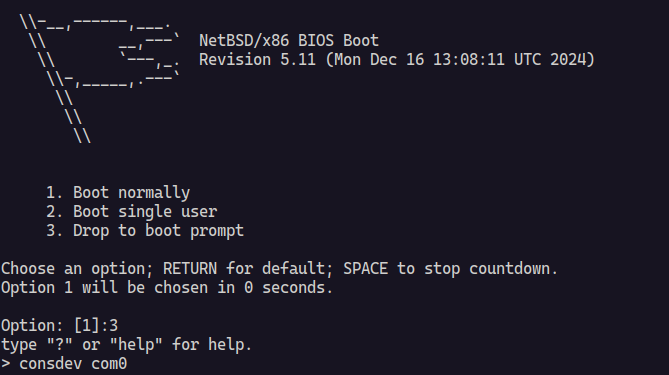
When NetBSD boots, you’ll see the boot menu. For the best experience with the serial console:
- 🔧 Select option
3. Drop to boot prompt - ⚙️ Configure console output:
consdev com0
boot
This enables proper console redirection to your terminal.
⚙️ Advanced Configuration
# Custom CPU, memory, and cores
netbsd-up --cpu host --memory 4G --cpus 4

# Save downloaded ISO to specific location
netbsd-up --output netbsd-10.1.iso

# Use existing disk image
netbsd-up --image vm-disk.img --disk-format qcow2

# Run VM in the background
netbsd-up --detach

# Custom port forwarding (SSH on port 2222, HTTP on port 8080)
netbsd-up --port-forward "2222:22,8080:80"

# Combine multiple options
netbsd-up --memory 8G --cpus 4 --detach --port-forward "3000:3000"
🛠️ Command Line Options
| Option | Short | Description | Default |
|---|---|---|---|
--output |
-o |
Output path for downloaded ISO | Auto-generated |
--cpu |
-c |
CPU type to emulate | host |
--cpus |
-C |
Number of CPU cores | 2 |
--memory |
-m |
Amount of VM memory | 2G |
--image |
-i |
Path to VM disk image | None |
--disk-format |
Disk image format | raw |
|
--size |
-s |
Size of the disk image to create if it doesn’t exist | 20G |
--bridge |
-b |
Name of the network bridge to use for networking (e.g., br0) | None |
--detach |
-d |
Run VM in the background and print VM name | false |
--port-forward |
-p |
Port forwarding rules (format: hostPort:guestPort) | None |
🔧 VM Management Commands
| Command | Description |
|---|---|
netbsd-up ps |
List all running virtual machines |
netbsd-up ps --all |
List all virtual machines (including stopped) |
netbsd-up start <name> |
Start a stopped virtual machine |
netbsd-up start <name> -d |
Start a virtual machine in background (detached) |
netbsd-up stop <name> |
Stop a running virtual machine |
netbsd-up restart <name> |
Restart a virtual machine |
netbsd-up inspect <name> |
Show detailed information about a VM |
netbsd-up rm <name> |
Remove a virtual machine from database |
netbsd-up logs <name> |
View logs for a virtual machine |
netbsd-up logs <name> -f |
Follow logs in real-time |
📚 Examples
⭐ Default NetBSD VM
netbsd-upStarts NetBSD 10.1 with 2 CPU cores and 2GB RAM.
🚀 High-Performance Setup
netbsd-up --cpus 8 --memory 8G --cpu host --detach🌐 Custom Port Forwarding
# SSH on port 2222, web server on port 8080
netbsd-up --port-forward "2222:22,8080:80"

# Development setup with multiple ports
netbsd-up --port-forward "3000:3000,5432:5432" --detach
💾 Development Environment with Persistent Disk
# Create a disk image first
qemu-img create -f qcow2 netbsd-dev.qcow2 20G

# Start VM with the disk
./main.ts --image netbsd-dev.qcow2 --disk-format qcow2
🔢 Specific versions
netbsd-up 10.1
netbsd-up 9.4
🔄 Background Operations
# Start VM in background
netbsd-up --detach

# Start existing VM in background
netbsd-up start my-vm --detach

# Monitor VM logs
netbsd-up logs my-vm --follow
🔧 VM Management Examples
# List all running VMs
netbsd-up ps

# List all VMs including stopped ones
netbsd-up ps --all

# Start a specific VM by name
netbsd-up start my-netbsd-vm

# Start a VM in the background
netbsd-up start my-netbsd-vm --detach

# Stop a running VM
netbsd-up stop my-netbsd-vm

# Restart a VM
netbsd-up restart my-netbsd-vm

# Get detailed information about a VM
netbsd-up inspect my-netbsd-vm

# Remove a VM from the database
netbsd-up rm my-netbsd-vm

# View VM logs
netbsd-up logs my-netbsd-vm

# Follow VM logs in real-time
netbsd-up logs my-netbsd-vm --follow
🌐 Networking
The VM supports flexible networking configurations:
🔌 Default Networking
- 🌐 QEMU’s user-mode networking (no special privileges required)
- 🔑 No default port forwarding (use
--port-forwardfor specific needs)
🔧 Custom Port Forwarding
Use the --port-forward option to map host ports to guest ports:
# SSH access on port 2222
netbsd-up --port-forward "2222:22"

# Multiple port mappings
netbsd-up --port-forward "2222:22,8080:80,3000:3000"
🌉 Bridge Networking
For advanced networking, use bridge mode (requires sudo):
netbsd-up --bridge br0📋 Version Format
NetBSD-UP recognizes version strings in the format:
- 🔢
MAJOR.MINOR(e.g.,10.1,9.3)
⚡ The tool automatically constructs the download URL for the official NetBSD release ISO.
⚙️ Default Settings
- 🏷️ NetBSD Version: 10.1
- 🖥️ CPU: host (uses host CPU features)
- 💾 Memory: 2GB
- ⚡ CPU Cores: 2
- 💿 Disk Format: raw
- 💾 Disk Size: 20GB (when creating new disk images)
- 🌐 Network: User-mode with SSH forwarding
- 🏷️ VM Names: Auto-generated unique names using random words
💾 Data Storage
NetBSD-UP uses a SQLite database (~/.netbsd-up/state.sqlite) to track virtual
machine states and configurations. The database stores:
- VM names and unique identifiers
- CPU, memory, and disk configurations
- Network settings (bridge, MAC addresses, port forwarding)
- Current status (RUNNING, STOPPED) with timestamps
- Creation and update timestamps
- Process IDs for running VMs
- Log file locations for each VM
📊 VM Logging
All VM output is automatically logged to ~/.netbsd-up/logs/<vm-name>.log. You
can:
- View logs:
netbsd-up logs <vm-name> - Follow logs in real-time:
netbsd-up logs <vm-name> --follow - Access logs directly from the filesystem
📄 License
See LICENSE file for details.
Contributing 🤝
Contributions are welcome! Please feel free to submit issues and pull requests.
Note
This tool is designed for development and testing purposes. For production NetBSD deployments, consider using proper installation methods.