🐡 openbsd-up

A comprehensive CLI tool to manage OpenBSD virtual machines using QEMU with minimal fuss. Create, start, stop, and manage multiple OpenBSD VMs with persistent state tracking.
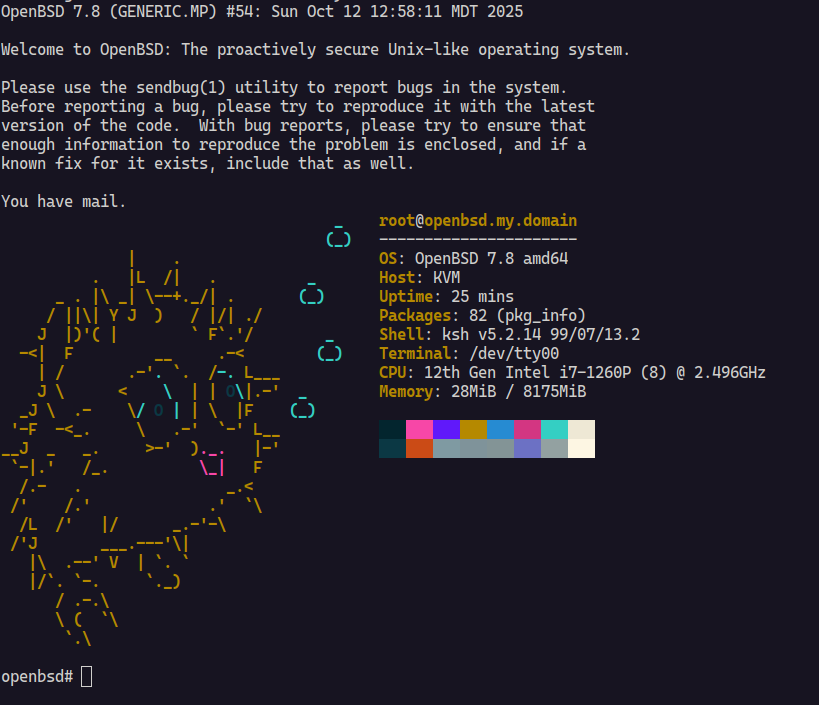
✨ Features
- 🚀 Quick Start: Launch OpenBSD VMs with a single command
- 📦 Auto-Download: Automatically fetches OpenBSD ISO images from official CDN or OCI registries
- 🔢 Version Support: Specify any OpenBSD version (e.g.,
7.8,6.4) - 💾 Flexible Storage: Support for persistent disk images in multiple formats with auto-creation
- 🐳 OCI Support: Push, pull, and manage OpenBSD VM images using OCI registries
- ⚙️ Configurable: Customize CPU, memory, cores, and more via TOML config file
- 🌐 Network Ready: Support for both NAT (SSH port forwarding) and bridge networking
- 🔌 Port Forwarding: Custom port mapping with
--port-forwardoption - 📝 Serial Console: Direct terminal access via
-nographicmode - 🗃️ VM Management: Persistent state tracking with SQLite database
- 📋 VM Lifecycle: Start, stop, restart, list, and inspect VMs with unique names
- 🗑️ VM Cleanup: Remove VMs and images with
rmandrmicommands - 📊 Logs Management: View and follow VM logs in real-time
- 🔄 Background Mode: Run VMs detached with
--detachoption - 🎯 Smart Detection: Automatically detects existing disk images to avoid data loss
- 🔗 Bridge Support: Automatic bridge network creation and QEMU configuration
- 🏷️ Image Tags: Tag and manage VM images with custom names
- 💽 Volume Management: Create, attach, list, and manage persistent volumes
- 🌐 HTTP API: RESTful API server for programmatic VM management
🛠️ Requirements
- Deno runtime
- QEMU with KVM support (
qemu-system-x86_64) curlfor downloading ISOssudoaccess (for bridge networking only)
📥 Installation
deno install -A -g -r -f jsr:@tsiry/openbsd-up🎯 Usage
Basic Examples
# Launch latest default version (7.8) - creates a new VM with random name
openbsd-up

# Launch specific OpenBSD version
openbsd-up 7.6

# Use local ISO file
openbsd-up /path/to/openbsd.iso

# Download from custom URL
openbsd-up https://cdn.openbsd.org/pub/OpenBSD/7.8/amd64/install78.iso
VM Management
# List running VMs
openbsd-up ps

# List all VMs (including stopped)
openbsd-up ps --all

# Start a specific VM by name or ID
openbsd-up start my-vm-name

# Start a VM in the background (detached mode)
openbsd-up start my-vm-name --detach

# Stop a running VM
openbsd-up stop my-vm-name

# Restart a VM
openbsd-up restart my-vm-name

# Remove a VM from state tracking
openbsd-up rm my-vm-name

# Inspect VM details and configuration
openbsd-up inspect my-vm-name

# View VM logs
openbsd-up logs my-vm-name

# Follow VM logs in real-time
openbsd-up logs my-vm-name --follow
Image Management
# Pull an OpenBSD image from an OCI registry
openbsd-up pull ghcr.io/tsirysndr/openbsd:7.8

# Push an OpenBSD image to an OCI registry
openbsd-up push my-openbsd-image:latest

# Tag an image
openbsd-up tag ghcr.io/tsirysndr/openbsd:7.8 my-openbsd:latest

# List local images
openbsd-up images

# Remove an image
openbsd-up rmi my-openbsd:latest

# Run a VM from an image
openbsd-up run ghcr.io/tsirysndr/openbsd:7.8

# Inspect image details
openbsd-up inspect ghcr.io/tsirysndr/openbsd:7.8
Volume Management
# List all volumes
openbsd-up volumes

# Attach a volume to a VM (creates volume if it doesn't exist)
openbsd-up start my-vm --volume data-volume

# Inspect volume details
openbsd-up volume inspect data-volume

# Remove a volume
openbsd-up volume rm data-volume
Configuration File
# Initialize a vmconfig.toml configuration file
openbsd-up init

# Start VM using configuration from vmconfig.toml
openbsd-up
Advanced Configuration
# Custom VM with persistent disk (auto-created if needed)
openbsd-up 7.8 \
  --cpus 4 \
  --memory 4G \
  --cpu host \
  --image disk.img \
  --disk-format qcow2 \
  --size 40G

# Run VM in background (detached mode)
openbsd-up 7.8 --detach

# Bridge networking (requires sudo)
openbsd-up 7.8 --bridge br0

# Custom port forwarding (host:guest port mappings)
openbsd-up 7.8 --port-forward 8080:80,3000:3000

# Save downloaded ISO to specific location
openbsd-up 7.8 --output ~/isos/openbsd-78.iso
🎛️ Command Line Options
Global Options
| Option | Short | Description | Default |
|---|---|---|---|
--output |
-o |
Output path for downloaded ISO | Auto-generated |
--cpu |
-c |
CPU type to emulate | host |
--cpus |
-C |
Number of CPU cores | 2 |
--memory |
-m |
RAM allocation | 2G |
--image |
-i |
Path to persistent disk image | None |
--disk-format |
Disk format (qcow2, raw, etc.) | raw |
|
--size |
Size of disk image to create if it doesn’t exist | 20G |
|
--bridge |
-b |
Name of the network bridge to use for networking (e.g., br0) | None |
--detach |
-d |
Run VM in the background and print VM name | false |
--port-forward |
-p |
Port forwarding rules (hostPort:guestPort, comma-separated) | None |
Subcommands
| Command | Description | Example |
|---|---|---|
ps |
List virtual machines | openbsd-up ps --all |
start <n> |
Start a stopped VM by name or ID | openbsd-up start my-vm |
stop <n> |
Stop a running VM by name or ID | openbsd-up stop my-vm |
restart <n> |
Restart a VM by name or ID | openbsd-up restart my-vm |
rm <n> |
Remove a VM from state tracking | openbsd-up rm my-vm |
inspect <n> |
Show detailed VM/image information | openbsd-up inspect my-vm |
logs <n> |
View VM logs | openbsd-up logs my-vm |
init |
Initialize a vmconfig.toml config file | openbsd-up init |
pull <image> |
Pull an OpenBSD VM image from registry | openbsd-up pull ghcr.io/user/openbsd:7.8 |
push <image> |
Push an OpenBSD VM image to registry | openbsd-up push my-openbsd:latest |
tag <s> <t> |
Tag an image with a new name | openbsd-up tag source:tag target:tag |
images |
List local images | openbsd-up images |
rmi <image> |
Remove an image | openbsd-up rmi my-openbsd:latest |
run <image> |
Run a VM from an image | openbsd-up run ghcr.io/user/openbsd:7.8 |
volumes |
List all volumes | openbsd-up volumes |
volume inspect <n> |
Inspect volume details | openbsd-up volume inspect data-volume |
volume rm <n> |
Remove a volume | openbsd-up volume rm data-volume |
serve |
Start HTTP API server | openbsd-up serve --port 8891 |
🖥️ Console Setup
When OpenBSD boots, you’ll see the boot loader prompt, enter the following command:
set tty com0
boot
🔌 Networking
The tool supports two networking modes:
NAT Mode (Default)
- SSH Port Forward:
localhost:2222→ VM port22(default) - Custom Port Forwarding: Configure with
--port-forwardoption - Network Device: Intel E1000 emulated NIC
- No special privileges required
Custom Port Forwarding Examples
# Forward host port 8080 to VM port 80
openbsd-up 7.8 --port-forward 8080:80

# Multiple port forwards
openbsd-up 7.8 --port-forward 8080:80,3000:3000,2222:22

# Access services after VM is running
curl http://localhost:8080  # Access VM's port 80
ssh -p 2222 user@localhost  # SSH to VM
Bridge Mode
- Direct Bridge Access: VM gets IP from bridge network
- Network Device: Intel E1000 emulated NIC with custom MAC
- Requires
sudoprivileges for QEMU bridge access - Automatically creates bridge network if it doesn’t exist
- Sets up QEMU bridge configuration in
/etc/qemu/bridge.conf
Connect via SSH after installation:
# NAT mode
ssh -p 2222 user@localhost

# Bridge mode (use VM's actual IP)
ssh user@<vm-ip-address>
�️ VM State Management
openbsd-up automatically tracks VM state using a SQLite database stored in
~/.openbsd-up/state.sqlite. Each VM gets:
- Unique ID: Auto-generated CUID for reliable identification
- Random Name: Human-readable names (e.g.,
ancient-butterfly) for easy reference - Persistent Config: CPU, memory, disk, and network settings preserved
- Status Tracking: RUNNING/STOPPED status with process ID tracking
- MAC Address: Consistent network identity across restarts
The state database allows you to:
- Resume VMs exactly as configured
- List all VMs with their current status
- Start/stop VMs by name or ID
- Inspect detailed VM configurations
💡 Tips
- 🐏 Allocate at least 2GB RAM for smooth installation
- 💿 ISOs are cached - re-running with same version skips download
- 📀 Disk images are auto-created if
--imagepath doesn’t exist - 🔒 Tool detects non-empty disk images and skips ISO mounting to prevent data loss
- 🏷️ Use VM names for easy management:
openbsd-up start my-web-server - 🌉 Bridge networking requires sudo but provides direct network access
- 📊 Use
openbsd-up ps --allto see both running and stopped VMs - 🔄 Use
--detachmode to run VMs in the background - 🔗 Configure custom port forwarding with
--port-forward host:guest - 📝 Monitor VM activity with
openbsd-up logs <name> --follow - 🗑️ Clean up unused VMs with
openbsd-up rm <name> - 💽 Use volumes for shared persistent storage across VMs
- ⚙️ Use
vmconfig.tomlconfiguration file for consistent VM setups - 🌐 Enable HTTP API for automation and integration with other tools
Creating Persistent VMs
# Create a VM with persistent storage
openbsd-up 7.8 --image my-server.qcow2 --disk-format qcow2 --size 40G

# Run a VM in the background
openbsd-up 7.8 --detach --image background-vm.img

# Later, restart the same VM (no ISO needed for installed systems)
openbsd-up start <vm-name>

# Monitor the VM logs
openbsd-up logs <vm-name> --follow
🌐 HTTP API
openbsd-up includes a RESTful HTTP API server for programmatic VM management:
# Start the API server (default port: 8891)
openbsd-up serve

# Start on a custom port
openbsd-up serve --port 3000
Authentication
The API uses Bearer token authentication. Set your token via environment variable:
export OPENBSD_UP_API_TOKEN="your-secret-token"
openbsd-up serve
If not set, a random token will be generated and displayed at startup.
API Endpoints
The API provides endpoints for managing:
- Machines:
/machines/*- Create, start, stop, list, and inspect VMs - Images:
/images/*- Pull, push, tag, list, and remove images - Volumes:
/volumes/*- Create, list, inspect, and remove volumes
Example Usage
# List all VMs
curl -H "Authorization: Bearer your-token" http://localhost:8891/machines

# Start a VM
curl -X POST -H "Authorization: Bearer your-token" \
  http://localhost:8891/machines/my-vm/start

# List volumes
curl -H "Authorization: Bearer your-token" http://localhost:8891/volumes
📝 Configuration File
Create a vmconfig.toml file to define default VM settings:
# Initialize configuration file
openbsd-up init
Example vmconfig.toml:
[vm]
iso = "https://cdn.openbsd.org/pub/OpenBSD/7.8/amd64/install78.iso"
cpu = "host"
cpus = 4
memory = "4G"
image = "openbsd.qcow2"
disk_format = "qcow2"
size = "40G"

[network]
port_forward = "2222:22,8080:80"

[options]
detach = false
Once configured, simply run openbsd-up to start the VM with your settings.
🔧 Architecture
Built with modern TypeScript and Deno, featuring:
- CLI Framework: Cliffy for robust command-line interface
- HTTP Framework: Hono for fast and lightweight API server
- Database: SQLite with Kysely query builder for type-safe operations
- State Management: Persistent VM state tracking with migrations
- Dependencies: Minimal runtime dependencies, leveraging Deno’s built-in capabilities
- Unique IDs: CUID2 for collision-resistant VM identifiers
- Human Names: Moniker for memorable VM names
📄 License
See LICENSE file for details. Licensed under Mozilla Public License v2.0.
🤝 Contributing
Issues and pull requests welcome!
Made with 🐡 for OpenBSD enthusiasts