Tirne







Tirne — from Old English “structure, strength” — a minimal web framework for Bun with Go-like control and zero boilerplate.
🚀 Tirne has been featured in this article on DEV.to,
where it received early reactions from:
- Ben Halpern (Founder of DEV.to & Forem)
- Nathan Tarbert
- Nevo David
We’re grateful for the attention and using the feedback to guide the next iterations.
📣 Minimalist? Bun enthusiast? OSS fan?
👉 Star Tirne on GitHub
We’re building a no-magic, Go-style framework for the Bun/TS world — and your star helps shape its future.
🚀 Quickstart
npx create-tirne-app 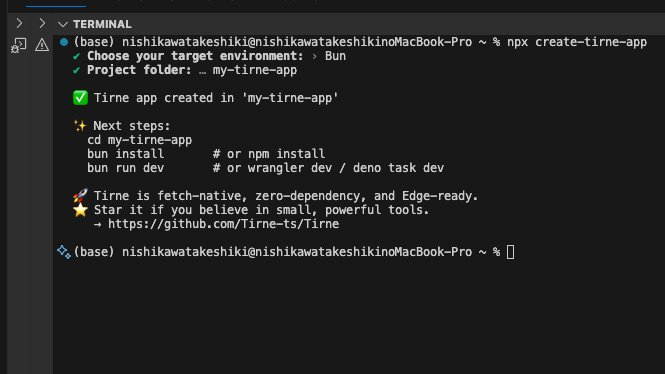
- Bun
- Deno
- Cloudflare Workers
- Netlify Edge Functions
This command sets up a ready-to-run Tirne project in seconds.
📣 Love minimal tools that get out of your way? Star the main Tirne repo: https://github.com/Tirne-ts/Tirne
📁 What You Get
A zero-boilerplate project, tailored for your runtime:
index.tswith a working router and a/endpoint- Runtime config files (
bunfig.toml,deno.json,wrangler.toml) package.jsonwith minimal scripts and dependencies
Example output:
✔ Choose your target environment: › Bun
✔ Project folder: › my-tirne-app

✅ Tirne app created in 'my-tirne-app'

Next steps:

  cd my-tirne-app
  bun install       # or npm install
  npm run dev       # or wrangler dev / deno task dev / netlify dev
🔧 Philosophy
Tirne is built on 5 core principles:
- Structure without abstraction — Everything visible, understandable, no magic.
- Functions over frameworks — Middleware, handlers, routers are just plain functions.
- Return errors, don’t catch them — Like Go: errors as values, not exceptions.
- Composition is explicit — No decorators or global state. Just
compose(middleware[]). - Run anywhere — Bun-native by design, but fetch-compatible for Node, Workers, Deno.
✨ Features
- ✅ Minimal HTTP router with dynamic path support
- ✅ Go-style middleware composition with full control
- ✅ First-class context: method, query, params, signal, env
- ✅ Response helpers:
json(),html(),text(),error() - ✅ Optional
Result<T, E>pattern for safe error handling - ✅ Simple structured parallelism:
runParallel(),waitAll() - ✅ Fully fetch-based — runs on Bun, Node, Cloudflare Workers, Deno
- ✅ No CLI, no file structure, no default config — just code
🧱 Core Responsibilities (Go-style)
| # | Responsibility | Description | Go Equivalent |
|---|---|---|---|
| 1 | Router | Static/dynamic route definition, method matching | http.ServeMux |
| 2 | Middleware Composition | compose() to separate and chain concerns |
http.Handler |
| 3 | Context | ctx = { req, res, env, signal, params } |
context.Context |
| 4 | Error Handling | Result<T, E> or handleError() structure |
error, if err != nil |
| 5 | Response Utility | json(), html(), text(), error() |
encoding/json, template |
| 6 | Parallelism | runParallel(), waitAll() async control |
go func(), WaitGroup |
🧱 Example with Middleware
import { createRouter, compose, json, error } from "tirne";

const logger = async (ctx, next) => {
  console.log(`[${ctx.method}] ${ctx.url.pathname}`);
  return await next();
};

const routes = [
  {
    method: "GET",
    path: "/",
    handler: compose([logger], ({ req }) => json({ hello: "Tirne" })),
  },
  {
    method: "GET",
    path: "/fail",
    handler: () => error("Something went wrong", 500),
  },
];

Bun.serve({ fetch: createRouter(routes) });
🔥 Tirne Philosophy – The 5 Articles of Bun-Style Backend
A web framework should be your toolbox, not your leash. Tirne follows five unapologetically minimal principles:
No abstractions you can’t inline Don’t hide behind magic. If it can’t be written in 5 lines, it probably shouldn’t exist.
Functions first. Frameworks last Apps should work without frameworks. Tirne is just the helper, never the master.
Handle failure like a grown-up No try/catch gymnastics. Return errors like Go. Predictable. Traceable. Safe.
Parallelism is a first-class citizen Use your CPU like a pro. Tirne assumes your code will scale, so it doesn’t get in the way.
Zero startup, zero lock-in, zero shame Start small, stay small if you want. Tirne doesn’t force structure or ceremony. One file is enough.
🔍 Tirne vs Hono vs Elysia — Key Differences
| Axis | Tirne ✨ | Hono 🌿 | Elysia 🧠 |
|---|---|---|---|
| Philosophy | Structure and control (Go-inspired) | Developer Experience and simplicity (Express-like) | Type-centric & macro-driven (type-first) |
| Routing | Function array (explicit structure) | app.get("/foo") chaining style |
app.get("/foo", {...}) with macros |
| Middleware | compose(fn[]) explicit composition |
app.use() global style |
onBeforeHandle and plugin/macro-driven |
| Type Safety | Lightweight, composable | Medium (some constraints) | Super strong, but complex |
| Response API | json(), error() as return values |
c.json(), c.text() methods |
set.response() — implicit injection |
| Extensibility | Functional middleware composition | Plugin-based | Decorator & macro-based |
| Dependencies | 🟢 Zero (100% custom) | 🟡 Lightweight (just Hono) | 🔴 Many (valibot, macros, swc, etc.) |
| Runtime Support | ✅ Bun / Deno / Workers/ Netlify | ✅ Bun / Node / Workers | ❌ Bun-only (not Deno-compatible) |
| Ideal Users | Go developers / Bun engineers | Express graduates / DX lovers | TypeScript-heavy / type maximalists |
Tirne is for those who value explicit control, minimalism, and portability over magic or tooling complexity.
Tirne keeps things predictable, portable, and programmable — not magic-driven.
📦 Install
bun add tirneTo use in Workers :
npm install tirneTo use in Workers or Deno:
- All core APIs are
fetch()-based — simply adapt routing to your runtime.
🤍 Use Cases
Tirne is ideal for:
- Bun-native HTTP APIs with zero setup
- Drop-in replacement for Express or Hono in Bun projects
- Cloudflare Worker endpoints (with fetch-compatible handlers)
- Building edge-friendly backends with structured code
💥 Ready to Write Real Code Again?
🚀 If you’re tired of magic, macros, and monoliths — try Tirne.
👉 ⭐️ Star on GitHub to join the movement.
📜 License
MIT