QUnitX






The oldest, most battle-tested JavaScript test API — now universal.
Run the same test file in Node.js, Deno, and the browser without changes. Zero dependencies. No config needed for Node. TypeScript works out of the box.
Why QUnit?
QUnit was created in 2008 by the jQuery team. While newer frameworks come and go, QUnit has quietly accumulated 16+ years of real-world edge-case handling that younger tools are still catching up to. Its assertion API is the most mature in the JavaScript ecosystem:
assert.deepEqual— handles circular references, prototype chains, Sets, Maps, typed arrays, Dates, RegExps, and getters correctlyassert.throws/assert.rejects— match errors by constructor, regex, or custom validatorassert.step/assert.verifySteps— declarative execution-order verification; catches missing async callbacks that other frameworks silently swallowassert.expect(n)— fails the test if exactly n assertions didn’t run; invaluable for async code where missing assertions would otherwise pass silently- Hooks —
before,beforeEach,afterEach,afterwith correct FIFO/LIFO ordering, properly scoped across nested modules - Shareable browser URLs — the QUnit browser UI filters tests via query params, so you can
share
https://yourapp.test/?moduleId=abc123with a colleague and they see exactly the same view
QUnitX wraps this API to work with Node.js’s built-in node:test runner and
Deno’s native test runner — no Jest, Vitest, or other framework needed.
QUnit includes the fastest assertion and test runtime in JS world. I’ve previously contributed to some speed optimizations to QUnit, we benchmark every possible thing to make it the fastest test runtime, faster than node.js and deno default assertions in most cases. Therefore I consider myself very objective when I say QUnit(X) is the best JS/TS testing tool out there.
Demo
Left window:
node --testanddeno testrunning the same file. Right window: QUnit browser UI with filterable, shareable test results.
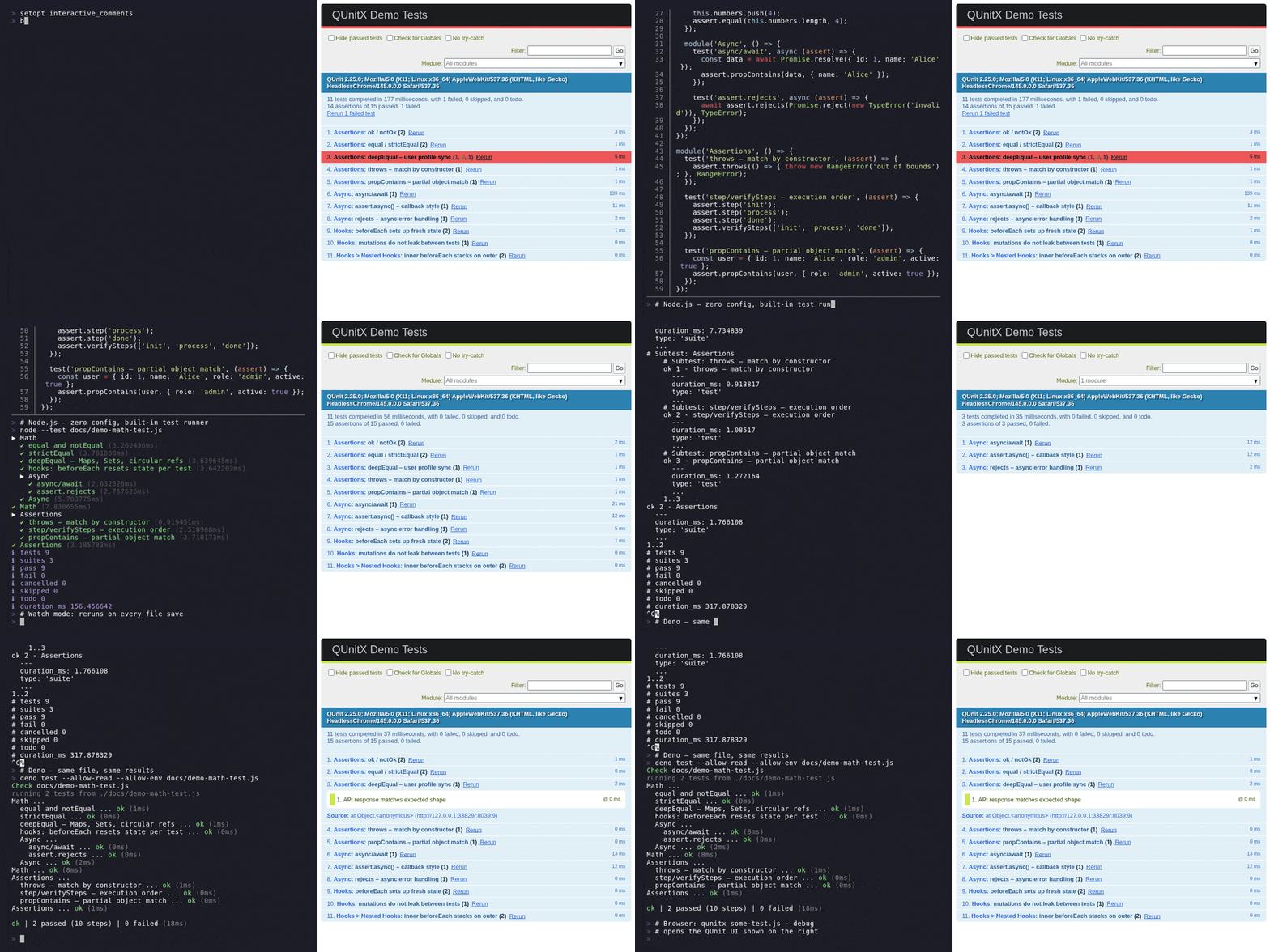
Live browser UI example (click to see filterable QUnit test suite):
objectmodel.js.org/test/?moduleId=6e15ed5f
Installation
npm install qunitx --save-devRequires Node.js >= 22 (LTS) or Deno >= 2.
Quick start
// math-test.js  (works in Node, Deno, and browser unchanged)
import { module, test } from 'qunitx';

module('Math utilities', (hooks) => {
  hooks.before((assert) => {
    assert.step('setup complete');
  });

  test('addition', (assert) => {
    assert.equal(2 + 2, 4);
    assert.notEqual(2 + 2, 5);
  });

  test('deepEqual', (assert) => {
    assert.deepEqual({ a: 1, b: [2, 3] }, { a: 1, b: [2, 3] });
  });

  module('Async', () => {
    test('resolves correctly', async (assert) => {
      const result = await Promise.resolve(42);
      assert.strictEqual(result, 42);
    });
  });
});
Node.js
# No extra dependencies — uses the Node built-in test runner
node --test math-test.js

# Watch mode (re-runs on save)
node --test --watch math-test.js

# Glob pattern
node --test --watch 'test/**/*.js'

# TypeScript (tsconfig.json with moduleResolution: NodeNext required)
node --import=tsx/esm --test math-test.ts

# Code coverage
npx c8 node --test math-test.js
Deno
# One-time: create a deno.json import map
echo '{"imports": {"qunitx": "https://esm.sh/qunitx/shims/deno/index.js"}}' > deno.json

# Run
deno test math-test.js

# With explicit permissions
deno test --allow-read --allow-env math-test.js
Browser
Use qunitx-cli to get browser test output in your terminal / CI, or to open the live QUnit UI during development:
npm install -g qunitx-cli

# Headless (CI-friendly — outputs TAP to stdout)
qunitx math-test.js

# Open QUnit browser UI alongside terminal output
qunitx math-test.js --debug
The browser UI lets you:
- Filter by module or test name (filter state is preserved in the URL)
- Share a link that reproduces the exact filtered view with a colleague
- Re-run individual tests by clicking them
- See full assertion diffs inline
Migrating from QUnit
One import line is all that changes:
// Before:
import { module, test } from 'qunit';

// After:
import { module, test } from 'qunitx';
Concurrency options
module() and test() accept an optional options object forwarded directly to the underlying
Node / Deno test runner:
import { module, test } from 'qunitx';

// Run tests in this module serially
module('Serial suite', { concurrency: false }, (hooks) => {
  test('first', (assert) => { assert.ok(true); });
  test('second', (assert) => { assert.ok(true); });
});

// Deno-specific: permissions, sanitizeExit, etc.
module('Deno file access', { permissions: { read: true }, sanitizeExit: false }, (hooks) => {
  test('reads a file', async (assert) => {
    const text = await Deno.readTextFile('./README.md');
    assert.ok(text.length > 0);
  });
});
How it works
| Runtime | Adapter |
|---|---|
| Node.js | Wraps node:test describe / it with QUnit lifecycle |
| Deno | Wraps Deno BDD helpers with the same QUnit lifecycle |
| Browser | Thin re-export of QUnit’s native browser API |
The browser path is literally QUnit itself, so you get full QUnit compatibility:
plugins, custom reporters, the event API (QUnit.on, QUnit.done, etc.), and the
familiar browser UI with zero extra layers.
Code coverage
Probably c8 isn’t even needed since qunitx runs as a dependency(rather than runtime) on node.js and deno.
# Node (any c8-compatible reporter)
npx c8 node --test test/

# View HTML report
npx c8 --reporter=html node --test test/ && open coverage/index.html
Browser-mode coverage is limited because qunitx-cli bundles test files with esbuild. Native ES import maps support in Puppeteer/Chrome would eliminate the bundling step and unlock v8 instrumentation for browser coverage.
Links
- QUnit API reference
- qunitx-cli — browser runner / CI reporter
- Node.js test runner docs
- Deno testing docs